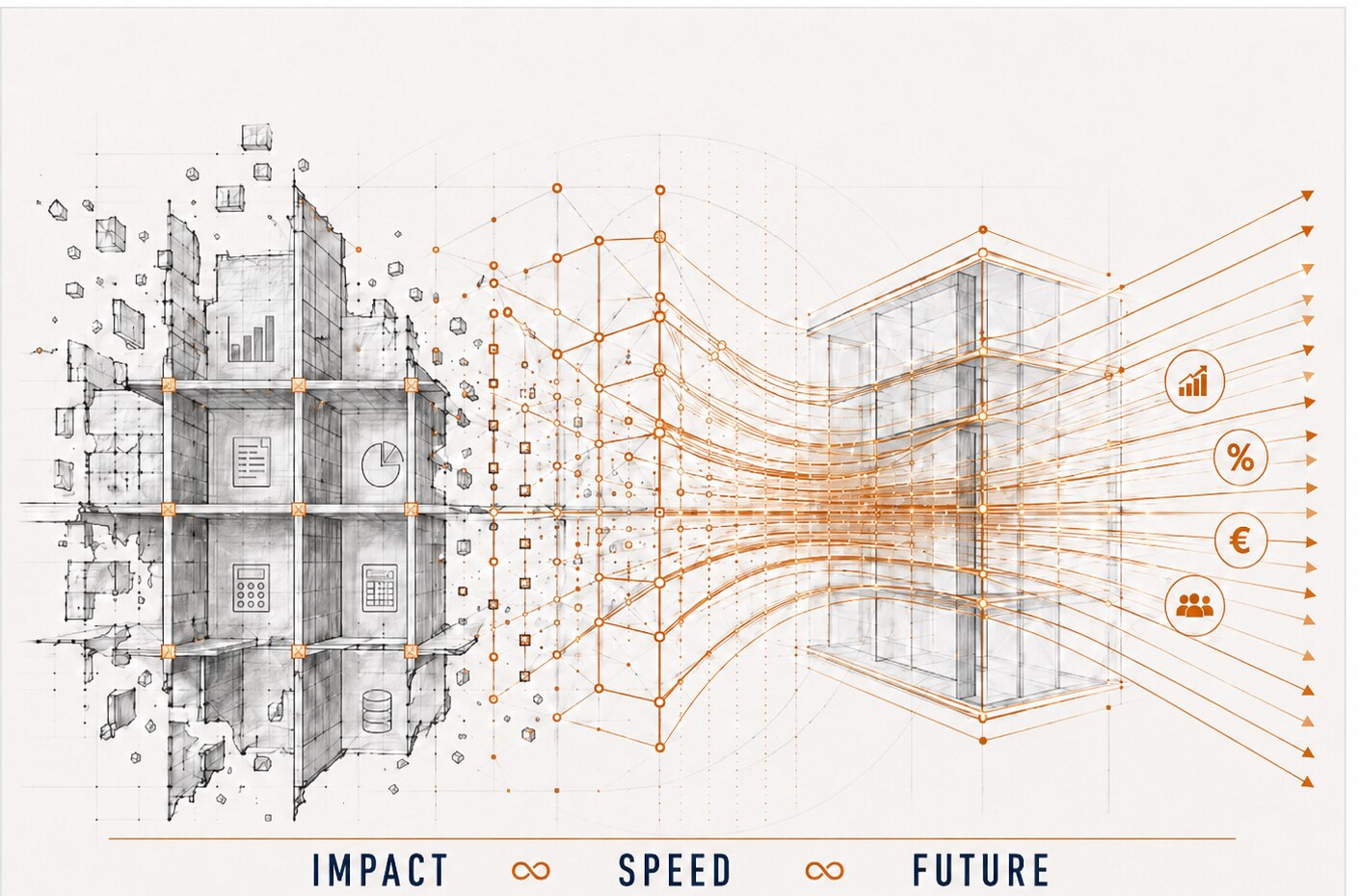
Flow-ready Enterprise Steering for the AI age
From cost-center-based steeringto a Human–AI-readyEconomic Performance Architecture.
We replace the cost center’s economic steering function with a WBS-based Economic Performance and Resource Architecture — while preserving accounting continuity and Financial Reporting Continuity. This creates the foundation for Human-in-the-Loop and Flowability.
The cost center can continue to serve technical and organisational purposes. WBS becomes the economic address for Economic Performance and Resource Consumption.
The mission
From organisational origin to Economic Performance.
Cost centers organise resources and accountability. Future-ready Enterprise Steering must also show what resources are used for, which Economic Performance is delivered, and who or what delivers it.
Cost center
Remains useful wherever it serves organisational and technical functions. It does not have to disappear from the ERP system.
WBS as the economic address
Economic Performance and Resource Consumption become economically addressable independently of organisational origin.
Additional Economic Performance Information
The existing financial view is complemented by information showing which resources were used for which Economic Performance.
Value Creation
Value Creation needs a flow-ready architecture.
Businesses have always understood Value Creation through economic relationships: customers, Economic Performance, bottlenecks, risk, capital, liquidity and future capability. The challenge is to represent those relationships adequately in Enterprise Steering and ERP use.
- Which Economic Performance is actually being delivered?
- Which resources and Capabilities are being used?
- Where are capacity and capital being tied up?
- What economic impact is being prepared or achieved?
- Where can management still intervene effectively?
Value Creation runs across functions. Enterprise Steering must be able to read those relationships as well.
Organisation, accounting, processes and ERP remain necessary. What changes is their economic connection.Human–AI Work Architecture
Human-in-the-Loop needs an economic accountability architecture.
In a Human–AI Work Architecture for the AI age, it is not enough for a person somewhere to approve an AI output. What matters economically is what humans and AI each contribute, which role carries accountability, and which capabilities, targets and guardrails are required.
Address Economic Performance
Human, technical and AI-enabled contributions are linked to a defined economic purpose.
Anchor accountability
Human-in-the-Loop is treated not merely as an approval point, but as an accountable role with a clearly defined Economic Performance and decision responsibility.
Assess impact
AI is assessed not only by output or speed, but in the context of Economic Performance, Resource Consumption and Economic Impact.
Stage 1
New Economic Performance Information.
No second financial world.
The economic steering architecture can be changed without destabilising financial statements, close processes or existing reporting.
- Accounting continuity is preserved.
- Accounting and closing logic continue to operate.
- Existing reporting remains continuous and reconcilable.
- Period comparability and financial continuity are preserved.
The existing financial view remains. Economic Performance Information is added.
This is a major advantage of the first transformation stage.Preparation and implementation
Prepare safely first.
Then implement without interrupting operations.
Reliable test environment
WBS, role, Economic Performance, resource and valuation logic are built, aligned and tested in an appropriate test environment.
Live operations
After validation, the solution is transferred into live operations in a controlled manner — without operational interruption and without prematurely switching off existing steering capability.
Flowability
The transition creates the foundation for Flowability.
The Flowability Scan remains a possible entry point: it shows how far the organisation is from its flow-ready target architecture.
View Flowability ScanEconomic perspective
Two websites.
Two clear roles.
real-efm.com presents the economic perspective on Economic Reality and Corporate Management under AI conditions.
fin-n-control.com translates that perspective into concrete Enterprise Steering and transformation.
Go to real-efm.com ↗Technical architecture of the future